
Grandview Past Residents by Era
The trail for previous residents of a Grandview address changes with the date. A recorder deed identifies a legal transfer, an assessment card supplies a current property connection, and a directory or census may supply household context. The table keeps verified coverage separate from unknown online cutoffs and unconfirmed local runs. A source can help explain a house without proving that every person tied to it occupied the address.
| Source | Years It Covers | Where Held | What It Shows |
|---|---|---|---|
| Recorder deeds and plat books | Copies since the 1800s; online cutoff not located | Jackson County Recorder and Archives microfilm | Legal transfers, grantor/grantee, lot or block, liens, and plats |
| Assessment and tax records | Current and certain prior years; odd-year assessment | Jackson County portal and Collection | Current owner, tax mailing address, values, exemptions, and tax status |
| Grandview suburban directory | 1975 verified; other runs not located | FamilySearch and Midwest Genealogy Center | Names and addresses with likely business or household context; surrounding-area scope |
| MGC Missouri directory shelf | Exact Grandview range not exposed | Midwest Genealogy Center, Independence | City, suburban, and telephone entries after catalog confirmation |
| Grandview High School yearbooks | 1963, 1975, 1977 verified | FamilySearch and MGC | Student names, class, photographs, and school affiliations |
| Federal census | 1830-1880 and 1900-1950 released under the 72-year rule; 1890 population schedules destroyed | NARA, FamilySearch, and MGC | Household, age, relationship, occupation, birthplace, and changing geography |
| Grandview permits | Current GOVBUILT submission; historical range not located | City Community Development and Public Works | Project, applicant, owner, contractor, inspection, and date evidence |
| Newspapers | Exact Grandview run not located | MGC, library databases, Examiner, Star, and Times holdings | Moves, obituaries, deeds, weddings, probate, and community notices |
| Sanborn maps | No confirmed Grandview-specific sheet located | Library of Congress and licensed MGC database | Building footprint, material, use, and street context, not an occupant list |
| State death certificates | 1910-present; Archives access after 50 years | DHSS and Missouri State Archives | Death and historical family clues, subject to the access rules |
For a recent transfer, begin with the assessment and Recorder path. For a 1975 household question, start with the verified suburban volume, then verify its wider geography. For older household questions, pair census and county records, and treat the 1890 loss as a known gap rather than a failed search.
Grandview Past Residents Need Three Keys
Insider tip: preserve three identifiers at every step: the situs address, the legal description, and the owner mailing address. The situs address is the parcel's physical location. It is easy to search but vulnerable to spelling differences, renumbering, and city-limit confusion. The legal description identifies the lot, block, subdivision, or metes-and-bounds land description and is more durable when a street number changes. The mailing address follows the tax recipient and may lead to a later recorded transaction, but it is not proof of residence.
The Jackson County Parcel Viewer can provide the parcel number, situs, legal description, districts, and owner panel. Its parcel dimensions are approximate, and easement research belongs in Recorder records. Save the printed form of an old street name too. An unverified historical renumbering should be treated as a research gap, not assigned a made-up conversion year.
Note: A clear legal description is the safest bridge when an address is absent, altered, or shared by a wider postal area.
Grandview Past Owners Through Deeds
Past residents research begins with the property relationship, then follows the chain of title backward. Use the Jackson County Assessment Public Property Portal or GIS to identify the current owner and legal description. Then use the official Jackson County Records/Aumentum entry point to search the owner as a grantee, or buyer, and match the deed to the same legal description. An address alone may not be consistently indexed.
- Record the current parcel number, situs address, owner mailing address, subdivision, lot or block, and legal description.
- Search the current owner as grantee and use the legal description to identify the purchase deed.
- Read or order the recorded image, then capture the grantor, grantee, execution and recording dates, document or book-and-page reference, and any cited earlier instrument.
- Search the seller, or grantor, as the earlier grantee on the same legal description and repeat the comparison.
- Search trust, corporation, estate, trustee, personal-representative, married-name, and middle-initial variants when the document calls for them.
- Stop only when the source changes, then mark the transition to a counter, historic book, microfilm, or archive source.
Three definitions keep the process clear.
- Grantor
- The person, estate, trust, or entity conveying an interest in a recorded document.
- Grantee
- The person, estate, trust, or entity receiving that interest. In a purchase deed, the grantee is the buyer.
- Chain of title
- The linked sequence of recorded transfers for the same property, read backward from a current deed.
- Legal description
- The recorded land description, such as a lot and block, that ties documents to the parcel more reliably than a changing street label.
Grandview Past Residents Beyond Online Indexes
The official pages reviewed do not state Aumentum's earliest public online year. Do not equate the online index with the Recorder's full holdings. The Recorder says certified copies can be obtained for documents recorded since the 1800s, which creates a documented fallback chain: Aumentum index or image, Recorder counter or email, historic deed books or microfilm, Missouri State Archives county microfilm, then MGC or FamilySearch if a digitized book exists.
Jackson County Recorder of Deeds accepts a focused request using a grantor or grantee, approximate recording date, legal description, subdivision and lot or block, book and page, or document number. The office lists copies at $2 for the first page and $1 for each additional page, plus $1 per document for certification. Confirm fees, the office destination, and the available format before requesting a copy.
Note: Record the document reference before leaving an index result, because it is the handoff between the online trail and older source formats.
Grandview Past Residents in 1975
The verified historical directory lead is Kansas City suburban directory: south, including Grandview, Mo., Hickman Mills, Mo., Martin City, Mo.. It was created by the Lions Club of Grandview, is dated 1975, contains 185 pages, and is identified as available online through MGC and FamilySearch. It is a valuable snapshot, but its wider suburban scope must remain attached to every result.
The MGC Jackson County history collection helps place that directory within a wider local-history search.
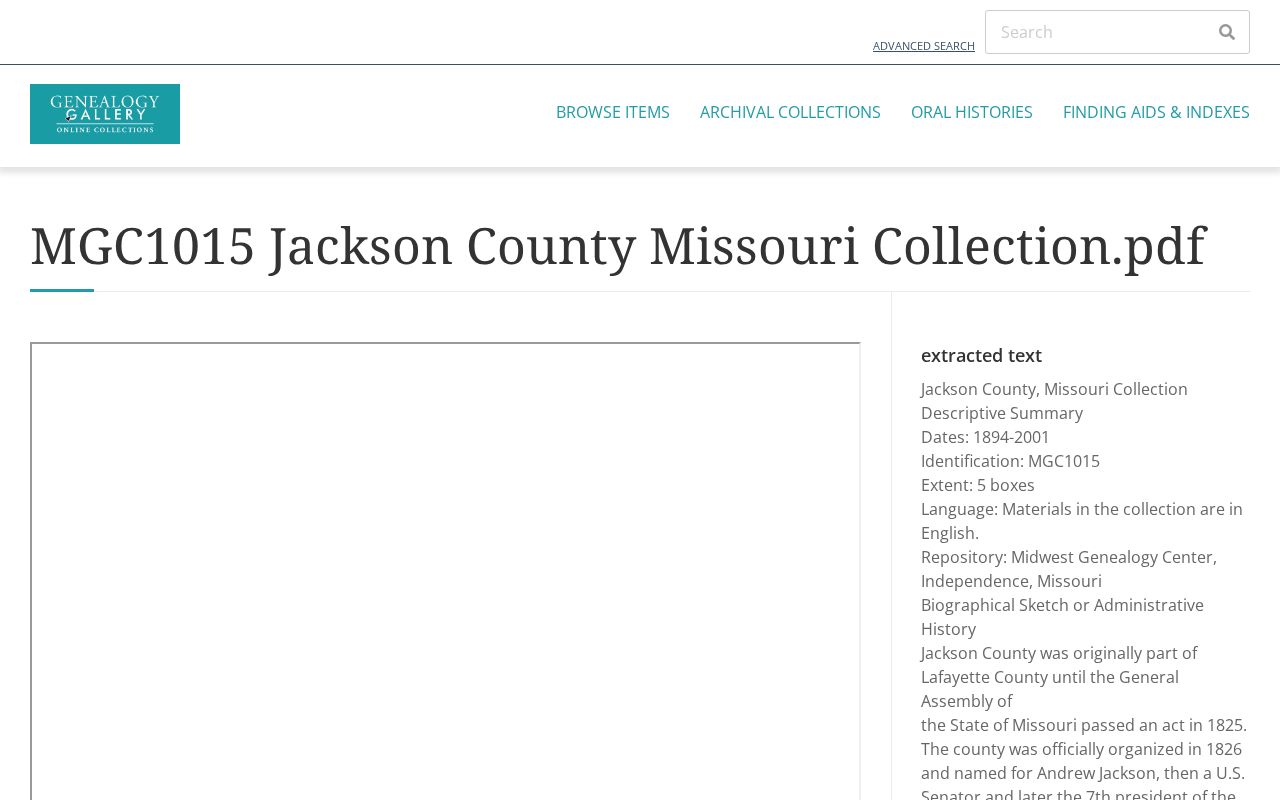
The collection can point to school publications, local-history material, and finding aids, while the exact Grandview directory run still requires item-by-item confirmation.
Grandview High School's Ga-Vue for 1963 and Bulldog for 1975 and 1977 offer confirmed companion dates. They can help identify classmates, school activities, or a year-specific address only when the item itself supplies that detail. The collections and how to read a historical directory are covered more fully in the Grandview city directories collection.
Grandview Past Households in Census Records
Deeds track ownership, not every person who lived in a house. Pair the directory date with the nearest released census to test the household. Census records can show names, relationships, ages, birthplaces, and occupations, while a city directory can supply a nearer annual address. Grandview's boundary growth means an older household may be recorded under Anderson District, a rural or township geography, or nearby Kansas City rather than the modern city label.
- Place the address and legal description on a dated timeline, leaving room for address changes.
- Use the verified 1975 directory or another confirmed local item to establish a dated name-and-address lead.
- Match the family to the nearest released census through names, ages, relatives, birthplace, and geography.
- Search MGC newspaper holdings for a move, marriage, death, business notice, military service, or probate transition.
- Use an obituary or probate file as an endpoint, then verify a person and property link with a second independent record.
Grandview Library offers public computers, catalog access, and a route to genealogy assistance. Its Kansas City Star Image Edition has a stated missing-content issue, so staff and MGC holdings are sensible fallbacks when a search produces no result.
The Grandview Library location page shows the branch resources that support past-resident and newspaper research.
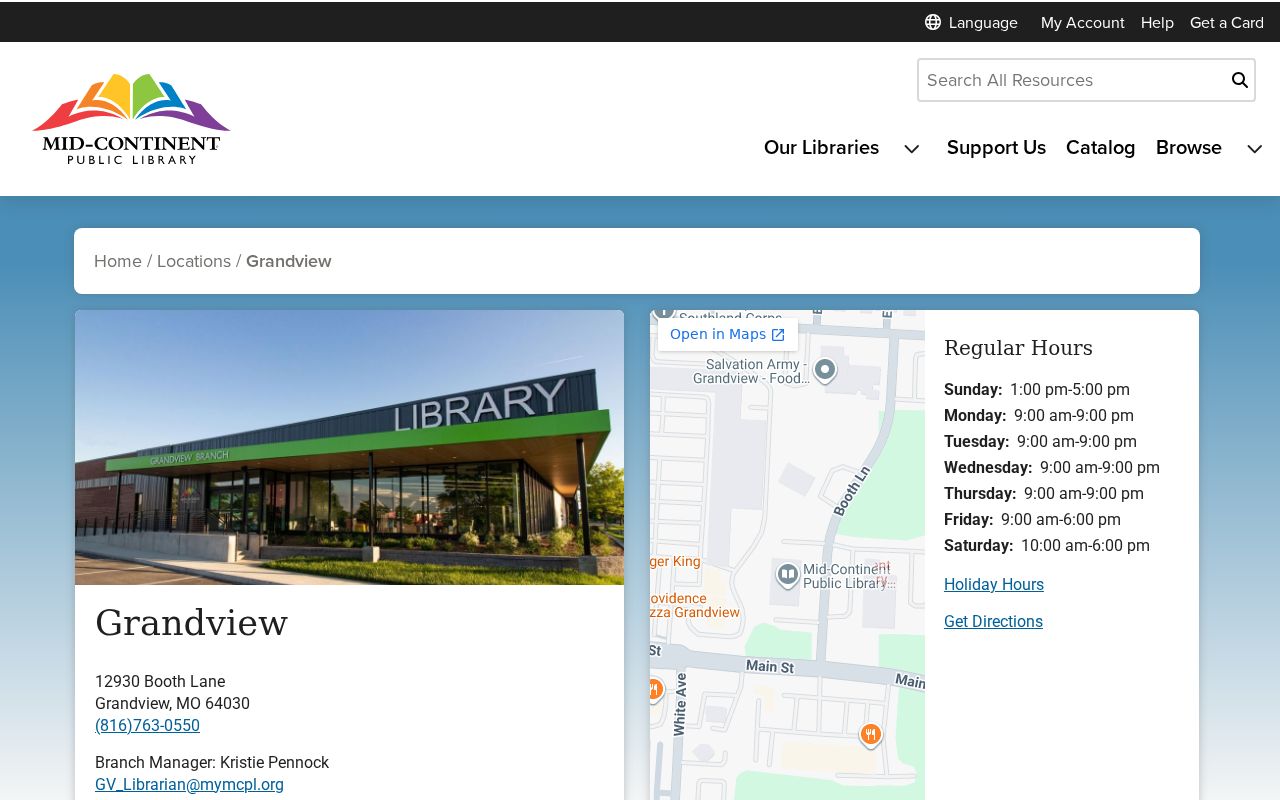
The branch provides a local work point before a deeper request at Midwest Genealogy Center in Independence.
Grandview Past Residents and Property Change
Permit and map records often date the building rather than the people in it. Grandview's permit information identifies GOVBUILT as the current application route. A permit file may contain a project, applicant, owner, contractor, plans, inspections, bond, or certificate-of-occupancy evidence. It does not prove that every named person lived at the address, and no historical public permit-search range was confirmed.
For earlier context, Grandview's Historic Preservation material identifies the Main Street Conservation District and a residential historic district tied to first subdivisions after the original platting around 1900. The Library of Congress Sanborn search guide requires a state, city, date or edition, and review of a map record. No Grandview-specific sheet or year was confirmed, so do not assign one without a live result. The 1904 Jackson County plat book can instead provide landowner-map context.
Grandview Past Residents Before City Growth
Grandview's records reflect its physical history. The city describes an Anderson District farm community that incorporated in 1912 and grew with the railroad and post office. Later development around Richards-Gebaur brought different community, school, permit, and newspaper trails. A deed, directory, plat, or census record may therefore use an older place label for the same general landscape.
The Truman Farm Home shows how a careful address history can be built. The Library of Congress HABS record documents the Grandview property, the 1867 construction, Harry Truman's residence there from 1906 through 1917, and later work. It is an address-level research model: compare property documentation, census, deed or plat, newspaper, and probate material. It is not a basis for treating a historic landmark as a current resident list.
Grandview Past Residents: Legal Limits
Past-resident work must stay tied to lawful personal, family-history, estate, or property-history research. A parcel card identifies an owner or tax contact, not every resident. A directory is a dated publication, not a complete household census. Public records can also have redactions, protected addresses, sealed files, and access rules that prevent a direct answer.
Lawful use. Use Grandview past-resident records to understand a family or property history, and do not use them to track, threaten, expose, or harass any living person. Missouri's anti-stalking and harassment provisions can apply when record information is misused.
When a person is linked to a death notice, the historical route can continue through the Missouri State Archives vital-record resources and a probate case. Death records over 50 years old may be available through the Archives under Missouri rules, while certified vital copies remain subject to separate eligibility requirements. Verify names, relationships, and property links with more than one source.