
Grandview City Directory Collections
Few Grandview runs are confirmed at the item level. The best lead is a Grandview-named suburban volume. It was digitized at FamilySearch Books through the Midwest Genealogy Center. The table separates the two. Confirmed dates sit apart from shelves and portals whose Grandview runs remain unproven. A Kansas City title alone is not proof of Grandview coverage in any particular volume.
| Collection | Years | Where Held | Access |
|---|---|---|---|
| Kansas City suburban directory: south, Lions Club of Grandview | 1975 | FamilySearch Books and Midwest Genealogy Center | Available online; 185 pages; includes Grandview, Hickman Mills, and Martin City |
| MGC Missouri city, county, state, and telephone directory shelf | Exact Grandview runs not exposed | Midwest Genealogy Center, Independence | Check the current microform list, catalog, or reference desk |
| Gate City Directory Co. Kansas City volumes | 1910 and other Kansas City years shown; Grandview inclusion unverified | FamilySearch and MGC | Inspect a suburban section before treating it as Grandview coverage |
| R. L. Polk Kansas City directories | Exact Grandview years not located | MGC and FamilySearch catalog | Search Grandview, suburban, south, and Jackson County terms |
| Missouri Digital Heritage collection | Local Grandview run not located | Missouri Digital Heritage | Free text search where a directory has been digitized |
| Grandview High School yearbooks | 1963, 1975, 1977 | FamilySearch and MGC | Companion material, not a directory run; online access can vary |
The confirmed 1975 volume covers suburbs. A hit might land on Grandview, Hickman Mills, or Martin City. Check the exact title and year. Never assume a gap means a family left Grandview. Grandview's first printed run and its last printed local year remain unidentified, as does any complete local telephone or reverse-directory sequence. Ask for the precise volume before drawing conclusions.
Note: A missing catalog result can mean the shelf, scan, or city coverage is simply unconfirmed, not that no Grandview directory ever existed.
Grandview City Directory Shelves
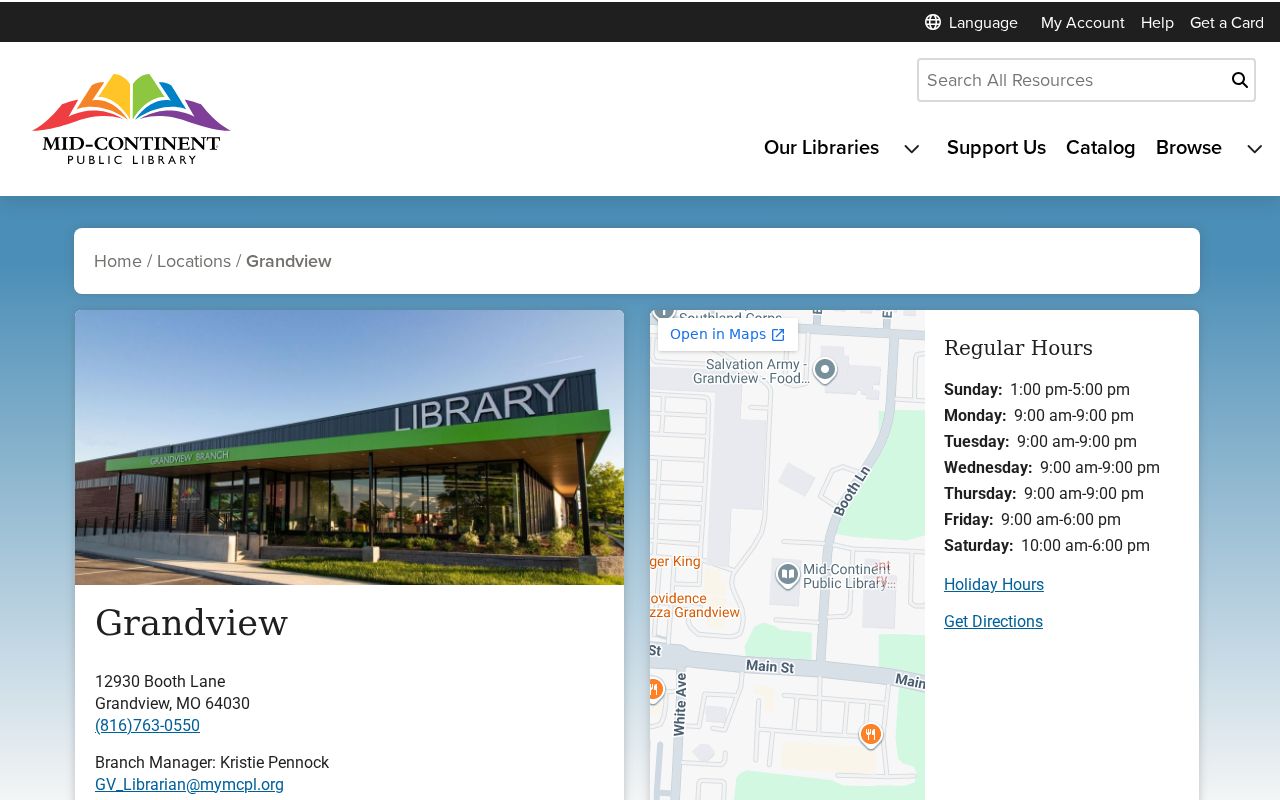
Start at the local branch. The Grandview branch of Mid-Continent Public Library offers computer sessions, catalog searches, copying, interlibrary loan, and the Kansas City Star Image Edition. Genealogy help runs through the Midwest Genealogy Center. Posted hours are Sunday 1-5, Monday through Thursday 9-9, Friday 9-6, and Saturday 10-6. Call ahead. The Grandview Library location page lists the branch resources that open a Grandview city directory search.
Midwest Genealogy Center, at 3440 S. Lee's Summit Road in Independence, is where the serious directory digging happens. The Grandview branch is easier to reach. But the deeper Jackson County collections live at the specialist center. Visitors there get databases covering censuses, newspapers, vital records, and more. The Genealogy Gallery adds another layer. It can surface names, places, oral histories, family papers, and local-history material. Finding aids matter too. A single aid can pinpoint a folder even when the item itself never made it online. For Grandview historical-research companions, the MGC Jackson County historical collection finding aid makes a sensible first stop.
The finding aid guides catalog searches by Grandview, Jackson County, surname, school, or neighborhood. It guarantees nothing for a given year.
Grandview City Directories Online
Missouri Digital Heritage's city-directory collection organizes directories alphabetically by resident or business and address. Digitized text searches by name, address, occupation, or date. Its holdings favor other Missouri cities. Treat it as a statewide route. It is no complete Grandview collection. For shelf work, pair the catalog with the published Missouri directories microform list. Search Grandview, south Kansas City, suburban, Jackson County, a street name, and a surname. Staff can separate a directory's publication place from its actual coverage. Access on FamilySearch can hinge on a library login.
Reading Grandview Directory Entries
Treat the entry inventory as a checklist. It applies to whatever Grandview volume lands in your hands. It does not promise that every field appears. Photograph the title page first. Note the abbreviation key too, because a single symbol can change what an address line means.
| Item to inspect | Why it matters |
|---|---|
| Alphabetical name listing | Check initials, married and unmarried names, nicknames, and spelling variants. |
| Street number and street name | Compare the form with a deed, plat, or later address before merging records. |
| Spouse or widow notation | Use it as a family-history lead, then corroborate it with another record. |
| Occupation or organization | It can separate same-name adults, but do not treat it as proof of a residence. |
| Telephone, forwarding, or residence mark | Record the symbol and consult the volume's key before interpreting it. |
| Street or reverse section | Confirm that the volume actually contains one before relying on address order. |
A few terms are worth keeping separate when reading an individual historical volume.
- Criss-cross directory
- An address-ordered directory that can connect a street number to a listed name. Its presence in a particular Grandview-related volume must be checked.
- Householder index
- An index arranged around the household or address, rather than a census-style list of every individual.
- Abbreviation key
- The publisher's explanation of shortened terms. Read it before assigning meaning to letters beside a name or address.
Note: Directory conventions differ by publisher, so read an abbreviation from its own volume rather than borrowing one from a national example.
A Grandview Directory Is a Snapshot
Myth: an old directory is a census of Grandview. It is not. A directory captures a single publication year. People drop out for many reasons. They were unlisted, moved, declined publication, lived outside the title's scope, or were simply not covered.
A disappearance can signal a move, a death, a changed name, or street renumbering. Agreement across records is the real test. A stable surname with a changed occupation may still be the same adult, so confirm with a deed, a voter record, an obituary, or census material. When a directory names a suburban district, preserve that wording instead of forcing a Grandview city address.
Trace a Grandview Directory Household
Build a dated household timeline. A directory is evidence, not a final identity ruling. Annual name and address listings bridge the long gaps between federal census releases. The 1900-1930 population schedules survive. Later schedules appear under the 72-year rule, and the 1890 schedules burned, with only the Civil War veterans schedule as a partial exception.
- Start with the surname, initials, married and unmarried names, and plausible spelling variants in the closest verified directory year.
- Copy the address exactly as printed, including an apartment, room, or street form if the volume shows one.
- Check the alphabetical and street sections when both exist, then record nearby entries without assuming they were relatives.
- Pair the directory date with the nearest released census, where household relationships, ages, birthplaces, and occupations can test the match.
- Use a newspaper notice, obituary, deed, or probate record to explain a move, death, or transfer before closing the timeline.
MGC's newspaper collection goes well beyond one title. Alongside the Independence Examiner, it holds the Kansas City Star, the Kansas City Times, and roughly 50 other Missouri papers. The Star's image resource has known missing-content problems, though. A dead-end newspaper search is rarely final. Check the catalog for the title and format, or ask staff directly. For present-day identity questions, a Grandview resident lookup is the right tool, since a historical directory cannot prove who lives in Grandview now.
Grandview Directories Across Change
Grandview started small. It began as an Anderson District farming community and incorporated as a city in 1912. Railroad and post-office growth shaped its early decades. The city counted just 700 residents in 1929. It expanded later around Richards-Gebaur Air Force Base. Those shifts explain why a historical residents directory search may move across many kinds of records. The material spans farm, deed, census, directory, school, community-newspaper, and military-era sources.
| 1867 | The Truman Farm Home's documented construction provides an address-level example for combining property and household sources. |
|---|---|
| 1906-1917 | Library of Congress documentation places Harry Truman at the farm home during this period. |
| 1912 | Grandview incorporated and became a railroad terminal, changing the names and institutions likely to appear in records. |
| 1975 | The verified Lions Club south suburban directory supplies a Grandview-inclusive directory snapshot. |
Two records anchor this timeline. The City of Grandview history and the Library of Congress Truman Farm Home record both supply local context. An old directory entry may name Anderson District. It may list Grandview, a rural township, or nearby Kansas City geography. The same landscape can carry different printed labels across the years. Keep the place name and legal description exactly as printed. Do not flatten every result into one modern label.
Grandview Directory Gaps
Gaps remain in the Grandview residents directory record. No first or last standalone Grandview volume is documented. The exact Grandview run on MGC's microform shelf is unclear. So are the precise fields in a 1975 household entry. The Grandview Historical Society's Depot Museum publishes no online catalog. Its holdings likely include artifacts and photographs. Directory contents and access rules should go through city history staff or the City Clerk.
When the shelf and digital portals fall short, the local branch still helps. Ask MGC staff for a directory or house-history lead. The Missouri State Archives county-microfilm guide lists older recorder, court, and probate material. Missouri's Archives cautions that courthouse losses can create gaps generally. No Jackson County-specific courthouse-loss inventory exists. Treat that as a reason to broaden the search. It is not proof that any particular Grandview record was destroyed.